
Hungarian agriculture – what are the challenges we are facing? – Precipices and predictions
Hungarian agriculture doesn’t face labour shortages: it faces a skills, capital and transition crisis. In this blog post I examine what are the root causes and also what are the challenges these cause not only for the agricultural sector, but also for society as a whole.
In the 1900s the technological advances and the storms of history caused a fundamental transfiguration in Hungarian agriculture – similarly to so many other countries. The structure of ownership, the amount of land owned by a single entity radically changed, just as who worked these lands or with those animals. While at the beginning of the previous century professional machinery was rare in Hungarian agriculture, today it is unimaginable to produce competitively without it. If we want to understand the scale of this transformation, it is enough to get familiar with two numbers: at the beginning of the last century close to 60% of the active adult population worked in agriculture, today this number is a mere 4,4%. This transformation didn’t only impact the size of the agricultural population: today the skillsets and knowledge needed in agricultural production are vastly different from what it was then. This transition was often swift, sudden and not without pain.
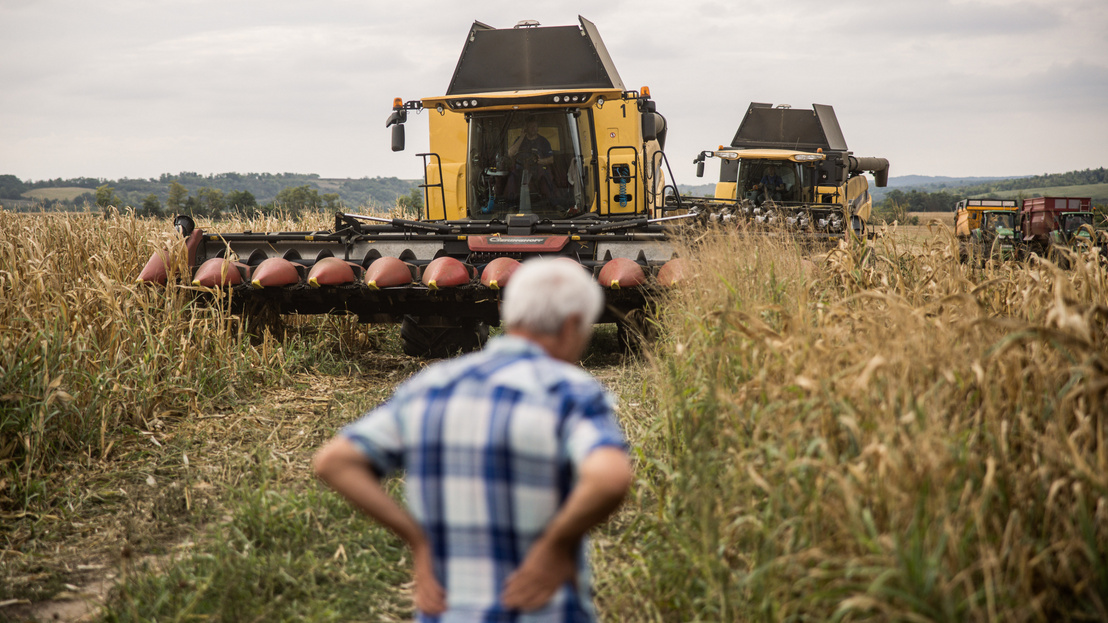
While machinery is not even a question by 2026, the radical transformation hasn’t stopped. Automation and robotization enter such territories of production, that was unimaginable even 10-15 years ago. The IoT and artificial intelligence are sitting at the table of production as if it always belonged there, making such professions completely obsolete that were invented less than 50 years ago.
What do these changes create as a challenge for the labour market in agriculture?
The precipice
The more intense the advance in agriculture, it creates more intense precipice between candidates and job openings. This always creates simultaneous unemployment and workforce shortage, because the skillsets, education and even often health condition offered by jobseekers are simply not on the level what farmers, employers need.
Just to see a classic example: one single machine with one driver can take over the job of 20 low-skilled workers. It is not given that the one driver will come from the 20 workers whose jobs become obsolete with the investment in the new machine. These machines more often than not require special driving licences. To gain such licence one usually needs at least 8 grades completed, that is far less common among the lowliest skilled workers that the majority of society thinks. Also to obtain such licences is often expensive. In fact, way too expensive for those impacted in such job loss to be able to find the resources to get them. As a result of these barriers of entry, we have 20 newly unemployed workers and one empty job.
But even more simple jobs – ones, that do not require any special certification, licence – constantly increase their demand when it comes to the skillset and knowledge of workers. The animals and plants on these farms are surrounded by more and more expensive, sensitive and/or difficult equipment to optimize production. The handling of this equipment does not necessarily require any special qualification, but more advanced basic skills are needed – way more advanced than – let’s say – 25 years ago. The root cause for this can be that their system may be not equipped with Hungarian interface, so they require at least an A1 level English or German knowledge, they may be very sensitive so they require way more advanced small motor skills to work around them, or they involve a lot of sensors, so strong physique and high tolerance for monotony is not enough anymore to work around them, but stronger and more long-lasting focus is also necessary. This leads to many people not adequate to do these jobs, while a lot of farmers battling severe workforce shortages.
To make it more difficult, this process is self-reinforcing. The constant workforce shortages are often handled by the farmers and companies by investing in tools, machines and systems aimed to replace human work. This solves their problems in the short term, even increases their efficiency, but obsoletes out even more people from the workforce and creates new workforce-shortages in the more added value segments of the workforce. So, we can safely say: the technological advancements do not solve workforce shortages, it simply transforms it to massive skill gaps.
It’s also important to note: these processes tend to price out smaller farmers from the market: they not only cannot create enough profit to have enough for such large investments, but the smaller production often cannot justify the investments for large, expensive machines and tools, as they are not worth or cannot be used in smaller scale production.
So, without policy-level interfering smaller producers priced out from the market, the workforce-shortages are constant and self-reproducing, while the lowest skilled active population – those whose last safety net for work opportunities was traditionally often agriculture – is (not so) slowly made obsolete from the workforce market.
It is not hard to see, that these tendencies need interference from societal level. The sustainability and health of agriculture, the safekeeping of agricultural traditions and the social protection of the (former?) workers of agriculture is extremely important of the safekeeping of our society, as a whole. Education, skill development, and employment need self-organizing agricultural communities, representing the needs and interests of all impacted parties. This can create the institutional ecosystems needed for sustainable employment, the brand development of agricultural careers and sustainable workforce- and talent pipeline in agriculture. And these are unbelievably crucial to decreasing the precipices!
Small farming and legacies
There is another precipice existing in agriculture: it’s between the small farmers (producing on 5-30 hectares or dealing with small stock populations) and between big, industrial-level farming.
As mentioned before, small farmers cannot necessarily invest in more expensive machinery or tools and often it is not profitable to invest in such for small scale farming. Because of these, small farmers – who are often family farms – develop an efficiency gap compared to big farming and because of this, they often get priced out from the market: they cannot sell their goods in a price that provides economical sustainability to continue farming. And this phenomenon accelerates in speed.
We can see that the small farmers competitive disadvantage is not due to capability, but the question of sizing and capital access.
This problem leads to the discontinuation of small farming in many cases, often when the next generation is due to take over the family business, as current generation slowly ages out of production and desires and ready to retire. The next generation saw the decreasing income due to the decreasing profit; they saw the uphill battle of their parents to keep the farm going and to keep up with the times. Because of this a lot of them at the point of choosing a profession or trade actively decided to go into different directions. The continuity is not only challenged by the decreasing income and the more difficult survival of the production, but the upcoming generations saw that the small farms cannot invest into the most modern technologies, so they see that taking over also means giving up on the pinnacle of the profession even before starting. Those technologies heading towards obsolescence are not exciting for them and prevent professional fulfilment.
Legacy building is not only challenging within family settings: agriculture as a career has a bad name in societal level: newcomers to the profession – those who don’t have a heritage background within a sphere – are rare and few. One without direct exposure to agriculture is even less likely to enter onto this route.
It is really important to understand: family farms though are not simply another participant of our economy. Agriculture is not simply a branch of our economy. It’s also identity forming. The abandonment of a family farm is not simply an economic event, but an emotional one as well in a way that rarely exists in other professional sectors. Family farmers are also the main guardians of our agricultural traditions. And very important: family farming creates and sustains local communities and local supply chains from seed corn/feed to pesticides, logistics, machine maintenance a lot of local economic actors are dependent on them, as big, industrial-level farmers are way more likely to rely on global supply chain instead. Also very important: small scale production is way more resilient against spreadable diseases, the localization if such a disease occurs and the small-scale farming is better in building and maintaining a more robust genetic material in their stock and crop. From local food security point of view, it is not hard to understand it is important if a disease shows up it’s not a “whatever” question if they need to euthanise 600 or 20 000 stock. The importance of this must be way more visible only a couple of years after a global pandemic creating gigantic chaos in global supply chain in record time, or at the same time when armed conflicts create food-scarcity panic for entire continents – it is enough to think that the Russian-Ukrainian war threatened mass famine in Africa when it looked like Ukrainian produced grain cannot be transported there.
We must say out loud: family farms are not simply economic participants, but vital parts of our social protection systems, local identity-building actors and load-bearing pillars of local sustainability, survival and resilience.
The solution here is the same: collective action. Small producers can only stay in competition with industrial-sized production if they act collectively: purchase machines and tools together, employ together (that also have the benefit of providing a more secure, trusted, reliable and less vulnerable employment for the workers), build services and apply for subscriptions (ex. disease-, pest-, useful insect, and weather tracking) invest together (ex. irrigation systems).
It is elementary, that small- and medium-sized farmers can only decrease their technological- and workforce disadvantages, precipices together with collective action. The shared employment-, education- and investment models are not only alternatives, but requirements for sustainable agricultural employment and incentivising it is a shared social interest across industries, demographics and views.
These are Hungarian challenges, but very rarely only ours.
The importance of skills management when it comes to managing simultaneous unemployment and workforce scarcity?
In 2019 one ILO publication phrased it this way: „A rapidly changing labour market, affected by technological evolution, globalization, demographic change and other mega‐trends, gives an impression of an expanding skills gap and brings greater urgency to policy implementation.”
Advances in technology phasing out more and more people from the workforce market?
Another ILO publication also from 2019:
„Technological advances – artificial intelligence, automation and robotics – will create new jobs, but those who lose their jobs in this transition may be the least equipped to seize the new opportunities. Today’s skills will not match the jobs of tomorrow and newly acquired skills may quickly become obsolete.”
High number of vulnerable jobs in agriculture?
Stephanie Steinmetz from the University of Amsterdam identified 46% of agricultural workers as working in „poor-quality jobs”, that’s far the highest among the sectors.
The importance of small farming and family farming when it comes to food security?
The FAO says: „Family farming plays a pivotal role in ensuring global food security. Producing more than 80 percent of the world’s food in value terms, family farms are central both to rural development and to building resilient, sustainable agrifood systems.”
Disease prevention advantages in small scale farming compared to industrial-level farming?
Another FAO quote: “the small-scale systems
may be less vulnerable to dramatic disease outbreaks than are industrial systems”
We must say out loud: all those challenges that Hungarian agriculture is facing are partially or fully present in the entire global sphere on some level.
Conclusion
Robotization, automation, IoT and AI can be a good thing, when it comes to necessary, but dangerous tasks or tasks that come with long-term negative health impacts. If these tasks are taken over by machines, less workers will die or lose health while trying to provide for themselves and their families. If the jobs that are staying and/or developing are higher added value jobs, that will lead to better pay, safer in short- and long-term, more likely to provide reliable living (less subject to seasonality, weather, crop- and stock epidemics) and more likely to provide quality interest representation for both workers and employers.
But… and this is a big but…. it can be only done without significant pain, without societal catastrophe, if we prepare on both national governance and international systemic levels to manage the fate of those active workers whose knowledge, skills and health are not ready to keep up with the changing times.
It is obvious: the management of all that comes with technological advances in agriculture is not only a question of economics and efficiencies, but a task for policymakers in labour, social and food security areas.